

24/7 AOG Critical Response
Hotline UK +44 1403 798888US +1 877 780 2008
Our award winning global AOG service is manned 24 hours a day, 365 days a year.
Please call +44 1403 798888 or email aog@ajw-group.com.
CLOSE
24/7 AOG Critical Response
HotlineUK +44 1403 798888US +1 877 780 2008
Our award winning global AOG service is manned 24 hours a day, 365 days a year.
Please call +44 1403 798888 or email aog@ajw-group.com.

AJW CUSTOMER ACCOUNT
Existing AJW customers can benefit from a secure online account, giving instant access to the real-time information you need, when you need it most.




24 Feb 2026

While holding a solid inventory is paramount to supporting customers’ needs, holding obsolete or too much stock can tie up funds that could be used elsewhere or invested for greater return. How does one manage parts inventory effectively while balancing service delivery and profitability?
To survive in the changing landscape of parts inventory management (PIM), MROs are learning to “plan, source and position inventory, accelerating a shift from reactive stocking to intelligent risk-based strategies,” says the article author, who references the ongoing labour shortage and ageing fleets post-pandemic as one of the causes of the challenge facing the industry.
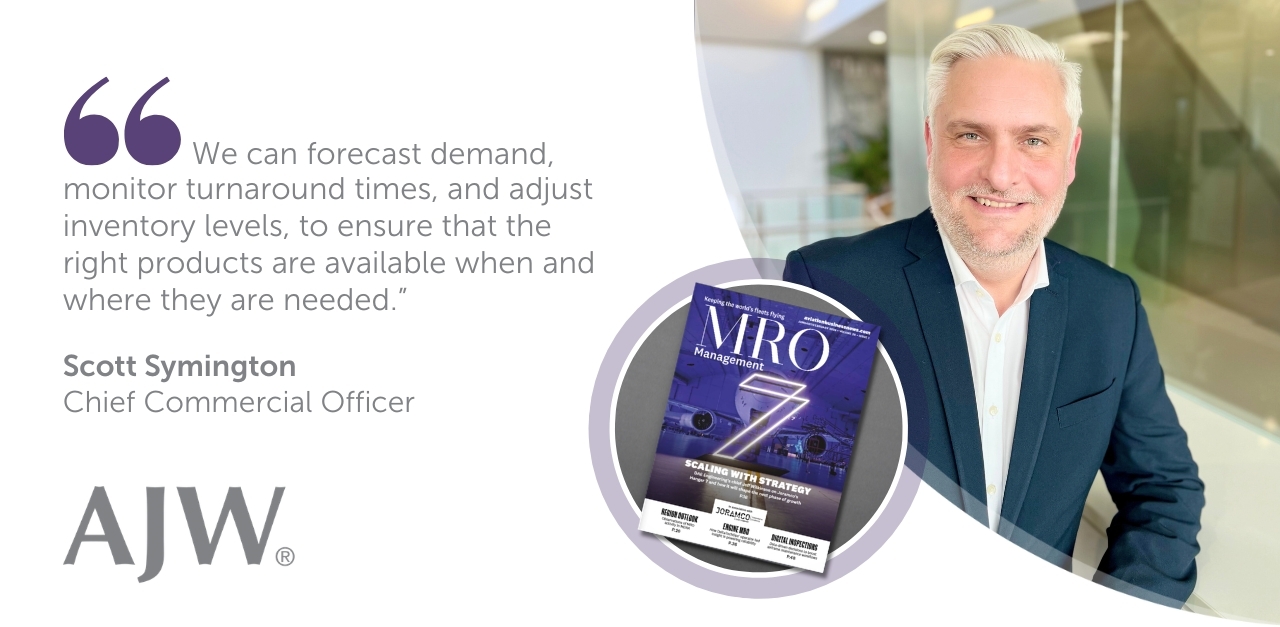
In its latest issue, MRO Management asks Chief Commercial Officer Scott Symington how businesses have adapted their operations to manage inventory effectively.
AJW Group has invested heavily and streamlined its inventory strategy and operational processes to ensure it can meet customer demands and provide reliable component availability. Referring to the Group's in-house optimisation tool, Apollo, Symington states that, “By implementing automated inventory tracking systems, we can streamline tracking and management processes, thus reducing errors and delays.” He explains that Apollo uses probabilistic modelling to guide ROI-driven stocking decisions across the business.
By strategically placing its 450,000 line items across its global hubs, including its Malpensa and Amsterdam warehouses, AJW can deploy components when and wherever they are needed, despite supply chain pressures and rising costs.
With ageing fleets now a bigger factor in MRO, has this impacted PIM operations, asks journalist Kevin Rozario?
The Chief Commercial Officer notes that ageing fleets have increased reliance on MRO providers such as the Group’s component MRO facility, AJW Technique. “We’ve been developing and investing in digitisation, which helps us optimise inventory storage and logistics, while ensuring we’re ready to respond quickly,” he says. Many of AJW’s airline customers are opting for Power-By-the-Hour (PBH) solutions, which transfer risk to providers like AJW that have large inventory pools for legacy and next-generation fleets.
What is the impact of digitisation, partnerships, and AI asks Rozario?
“AJW’s digital transformation has been the most significant development brought about by supply chain disruptions, “ states Symington, “we can forecast demand, monitor turnaround times, and adjust inventory levels, to ensure that the right products are available when and where they are needed,” he concludes.
The article’s concluding remarks offer insight, and some might say, a warning, to the industry. With the development of more advanced digital tools, effective PIM is set to separate the stakeholders who will survive from those who will drop off. “PIM is poised to become a source of competitive advantage [and] organisations that treat inventory not as a static cost centre, but as a strategic capability,” are the ones who will thrive.”

Looking to get a competitive advantage through improved supply chain management?



 RSS news
©2026 A J Walter Aviation Limited



 Email to my diary