

24/7 AOG Critical Response
Hotline UK +44 1403 798888US +1 877 780 2008
Our award winning global AOG service is manned 24 hours a day, 365 days a year.
Please call +44 1403 798888 or email aog@ajw-group.com.
CLOSE
24/7 AOG Critical Response
HotlineUK +44 1403 798888US +1 877 780 2008
Our award winning global AOG service is manned 24 hours a day, 365 days a year.
Please call +44 1403 798888 or email aog@ajw-group.com.

PBH CUSTOMER PORTAL
A secure online portal for existing AJW PBH customers. Manage exchange orders, track shipments, monitor repairs, access documentation, and communicate with support in real time.




27 Apr 2026

Inventory management has become one of the most strategically important functions in aviation maintenance and supply chain operations. The post-pandemic landscape has fundamentally reshaped how the industry approaches stock positioning, demand forecasting, and capital allocation. How are businesses managing their inventories? AviTrader MRO 360 investigates.
In the latest issue of AviTrader MRO 360, writer David Dundas asks industry professionals, including AJW Group’s Director of Head of Asset Management Lindsay Cooper, about post-pandemic recovery and how supply chain volatility has changed inventory strategies. He enquires about the impact of data inputs on demand forecasting, the primary inefficiencies within existing inventory systems, the influence of pooling agreements on internal stock levels, and delves into the hot topic of AI’s influence on spare parts forecasting.
Gone are the days when lean efficiency alone could drive competitive advantage. Today's operators and service providers must navigate a more complex equation: balancing resilience against cost, anticipating disruption whilst maintaining flexibility, and making data-driven decisions in an environment where supply chain volatility remains a persistent challenge. “Forecasting starts with clean, reliable demand history, but it’s the context around that data that drives accuracy. It’s not one dataset that matters most; it’s how well you connect them to build a realistic picture of future demand," says Cooper.
The stakes are high, especially when inefficient inventory decisions run across operations, overstocking ties up capital that could be deployed elsewhere, whilst understocking directly impacts aircraft availability and customer satisfaction. The Group Director of Asset Management notes that, “Holding inventory isn’t the problem; however, holding the wrong inventory is. The focus must be on understanding what truly moves, what supports your customers, and what is simply tying up cash. Getting that balance right is where strong inventory management adds real value.”
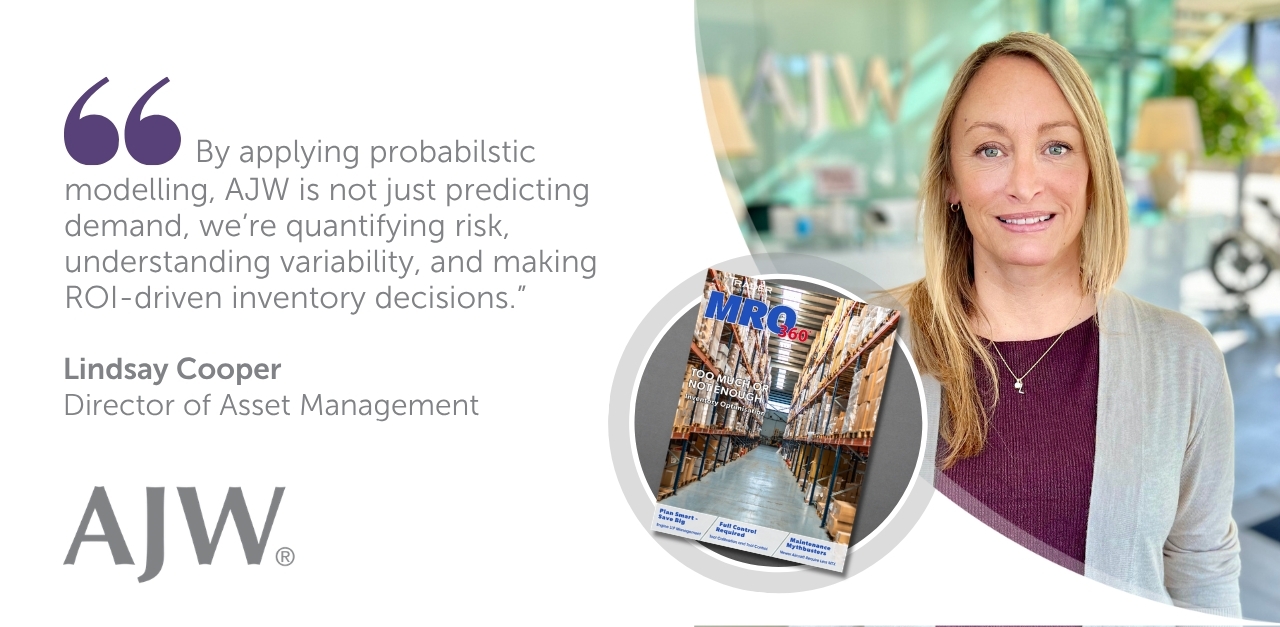
Cooper makes it clear that the real opportunity lies in understanding the nuances of demand patterns, leveraging operational visibility, and deploying advanced analytics to move from reactive supply management to proactive, intelligent positioning.
As the industry continues to evolve, leading organisations are recognising that inventory optimisation is no longer just about having the right parts in the right place. It's about having the right data, the right tools, and the right strategy. “There is now far greater openness to alternatives such as USM, driven by the need to maintain service levels in a constrained supply environment,” states Cooper, “AI is already reshaping forecasting, but the real differentiator is how effectively it’s applied in a commercial environment. By applying probabilistic modelling, AJW is not just predicting demand; we’re quantifying risk, understanding variability, and making ROI-driven inventory decisions.”




 RSS news
©2026 A J Walter Aviation Limited



 Email to my diary