

24/7 AOG Critical Response
Hotline UK +44 1403 798888US +1 877 780 2008
Our award winning global AOG service is manned 24 hours a day, 365 days a year.
Please call +44 1403 798888 or email aog@ajw-group.com.
CLOSE
24/7 AOG Critical Response
HotlineUK +44 1403 798888US +1 877 780 2008
Our award winning global AOG service is manned 24 hours a day, 365 days a year.
Please call +44 1403 798888 or email aog@ajw-group.com.

PBH CUSTOMER PORTAL
A secure online portal for existing AJW PBH customers. Manage exchange orders, track shipments, monitor repairs, access documentation, and communicate with support in real time.




27 May 2026

Hidden away in the tail section of every aircraft, the Auxiliary Power Unit (APU) powers everything from cabin lighting to air conditioning, hydraulics, and engine start. Yet despite its critical role in day-to-day operations, APU maintenance often flies under the radar. When an APU fails, however, the impact is anything but invisible, grounding aircraft, disrupting schedules, and creating significant operational and financial headaches for airlines worldwide. AviTrader MRO 360 investigates how airlines effectively navigate the maintenance of the APU.
APUs are fundamental to reliable turnarounds, yet their maintenance remains complex, costly, and often unpredictable. With life-limited parts driving shop visits, unscheduled removals creating budget surprises, and maintenance intervals varying widely depending on aircraft type and operating environment, airlines need expert guidance to navigate this critical component effectively.
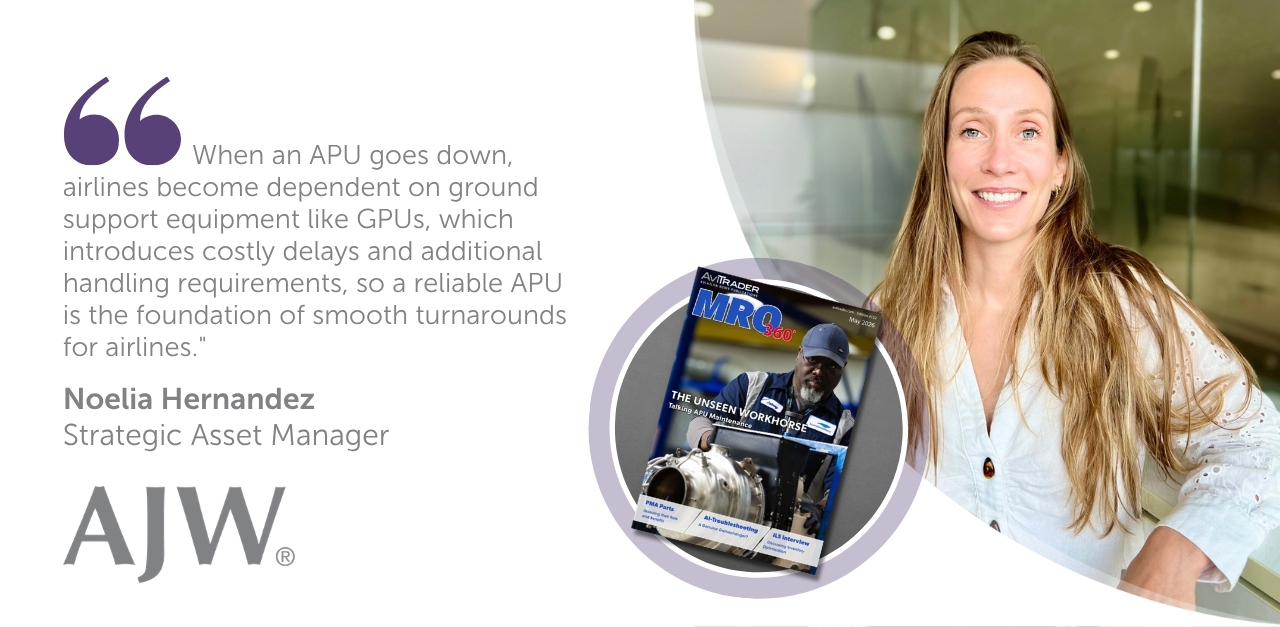
According to Noelia Hernandez, Strategic Asset Manager at AJW Group, the stakes couldn't be higher. She describes the APU as "fundamental" to day-to-day operations, emphasising that reliability directly impacts both turnaround efficiency and on-time performance.
‘When an APU goes down, airlines become dependent on ground support equipment like GPUs (Ground Power Units), which introduces costly delays and additional handling requirements, so a reliable APU is the foundation of smooth turnarounds for airlines,’ Hernandez explains. This dependency extends beyond mere inconvenience; it cascades through schedules, increases fuel burn and emissions, and ultimately impacts an airline's bottom line.
But understanding the problem is only half the battle. What matters is knowing how to manage it effectively.
Hernandez points to a fundamental shift in how forward-thinking airlines are approaching APU reliability. ‘First, they're minimising unnecessary APU operation by utilising ground power when available (GPU). They're partnering with independent MRO providers who deliver faster turnarounds and greater flexibility. Lastly, they're strategically using serviceable (SVC) components with remaining life rather than using new parts,’ she notes.
This multi-layered approach, combining operational discipline, strategic partnerships, and intelligent component management, is enabling airlines to balance maintenance spend with operational effectiveness. It's a competitive advantage in today's margin-conscious environment.
The shift towards predictive and condition-based maintenance is also transforming how operators plan APU interventions. Rather than adhering to rigid schedules, data-driven strategies allow airlines to maximise the utilisation of life-limited parts and keep units on wing until performance degradation is observed. This proactive approach reduces both unscheduled removals and unnecessary shop visits.
‘Commercial strategies also play a role,’ Hernandez adds. ‘Power-by-the-hour agreements provide cost certainty and access to serviceable units, helping minimise downtime during maintenance events. There's also a clear shift towards serviceable, overhauled material in place of new OEM parts, without compromising reliability.’
The bottom line is that airlines that embrace data-driven maintenance planning, leverage specialist MRO partnerships, and optimise their component strategies are discovering they can maintain reliability whilst controlling costs, a winning formula in today's competitive landscape.




 RSS news
©2026 A J Walter Aviation Limited



 Email to my diary