

24/7 AOG Critical Response
Hotline UK +44 1403 798888US +1 877 780 2008
Our award winning global AOG service is manned 24 hours a day, 365 days a year.
Please call +44 1403 798888 or email aog@ajw-group.com.
CLOSE
24/7 AOG Critical Response
HotlineUK +44 1403 798888US +1 877 780 2008
Our award winning global AOG service is manned 24 hours a day, 365 days a year.
Please call +44 1403 798888 or email aog@ajw-group.com.

PBH CUSTOMER PORTAL
A secure online portal for existing AJW PBH customers. Manage exchange orders, track shipments, monitor repairs, access documentation, and communicate with support in real time.




17 Jul 2026

Airlines and MRO operators speak confidently about digital transformation, yet many struggle to translate strategy into operational reality. The questions facing the industry are no longer theoretical: What is digitalisation? Where are organisations failing to bridge the gap between vision and delivery? And what will MRO operations look like a decade from now if current progress continues?
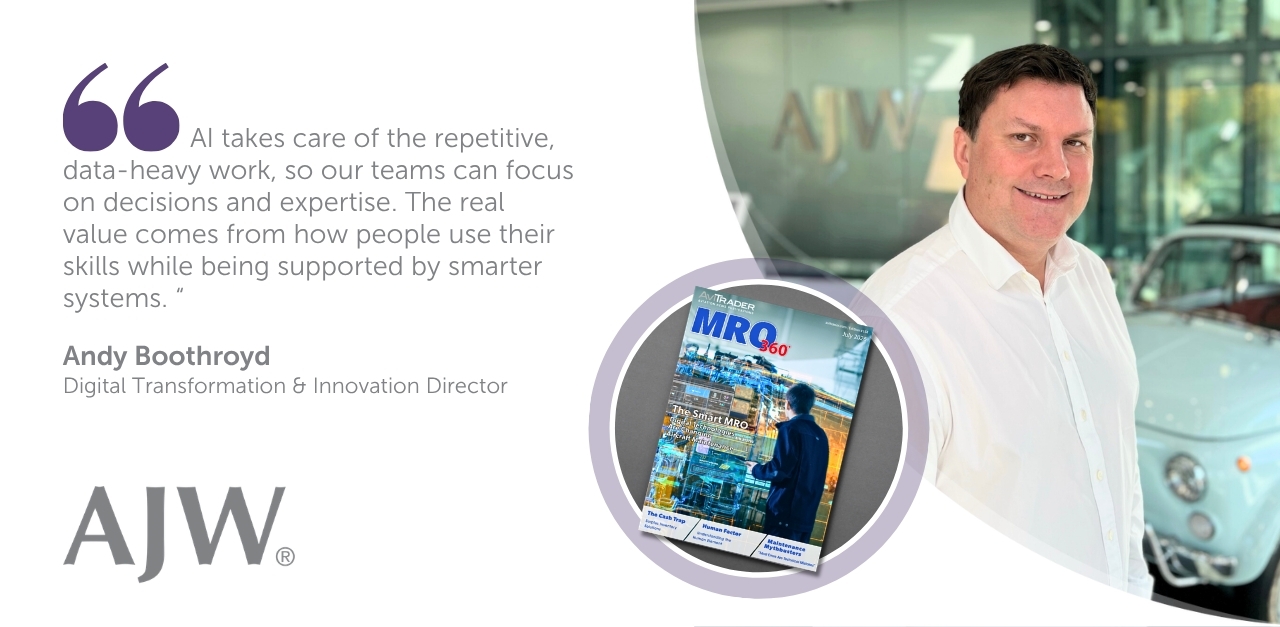
In the latest issue of AviTrader MRO 360, journalist David Dundas speaks to AJW's Digital Transformation & Innovations Director Andy Boothroyd, exploring the state of digital transformation in MRO. He examines the emerging technologies reshaping maintenance operations, the critical skills gap affecting the next generation of professionals, and the processes that continue to resist change. More importantly, we try to understand what digitalisation delivers, and where the industry's opportunities and challenges lie.
How would you define “digitalisation” in the context of MRO today?
Digitalisation is about putting the right data in front of people at the right time, so they can make quicker, better decisions, whilst reducing manual effort. It’s about joining everything up- data, systems, and people working together as one, to create a faster, more responsive, and genuinely customer-focused operation.
Where do you see the biggest gap between digital ambition and execution in the industry?
Systems must work collaboratively across the wider industry, not just within one organisation; this is where a gap exists. As an industry, we’re still missing consistent, scalable ways to share trusted data, as there is still some hesitation when it comes to sharing information more openly.
AJW's approach is to focus on building a digital supply chain with a single source of truth, so that traceability, compliance, and transaction data move more easily between partners.
What will MRO operations look like in ten years’ time if digitalisation continues at the current pace?
The biggest shift will be stripping out the non-value-added tasks. We’re taking a human-led approach, backed by smart automation, by giving our people better tools and not replacing them. AI takes care of the repetitive, data-heavy work, so our teams can focus on decisions and expertise. The real value comes from how people use their skills while being supported by smarter systems.
Which emerging technologies are you most optimistic, or sceptical, about?
AI is generating the most momentum right now, particularly agentic AI, because it fits so naturally into the kind of knowledge-heavy work we see in MRO. We've built it into our operations to help drive workflows and support better decision-making.
Where we’re a bit more cautious is with technologies that only work if the whole industry moves together, so our focus is on what we can deploy and deliver value from today, while still building the foundations for more transformation over time.
What skills are becoming essential for the next generation of MRO professionals?
They’ll need a blend of strong technical skills and digital confidence. The engineering fundamentals don’t go away, but they’re now required alongside the ability to work with data and AI-driven tools.
That said, there must be an emphasis on critical thinking skills and the ability to make judgement calls. In a safety-critical environment like aviation, people still need to sense-check and validate what the technology tells them, but not blindly trust it.
What processes in MRO remain stubbornly resistant to digital transformation?
Things like airworthiness certification and component history are still heavily reliant on manual processes and physical documents. That’s not because the technology isn’t there; it’s more about the need for industry-wide trust, alignment, and standardisation.
We can optimise what is within our control, but the real change comes from connecting the wider ecosystem so that trusted data can move more freely between parties.
The future of aviation support will be shaped by how effectively organisations integrate digital capability into existing operational models. Progress won’t happen overnight; it will take time, because accuracy and compliance will always come before speed.
Interested to know how AJW's digitalisation is enhancing service delivery for you?




 RSS news
©2026 A J Walter Aviation Limited


 Email to my diary