
24/7 AOG Critical Response
Hotline UK +44 1403 798888US +1 877 780 2008
Our award winning global AOG service is manned 24 hours a day, 365 days a year.
Please call +44 1403 798888 or email aog@ajw-group.com.
CLOSE
24/7 AOG Critical Response
HotlineUK +44 1403 798888US +1 877 780 2008
Our award winning global AOG service is manned 24 hours a day, 365 days a year.
Please call +44 1403 798888 or email aog@ajw-group.com.

PBH CUSTOMER PORTAL
A secure online portal for existing AJW PBH customers. Manage exchange orders, track shipments, monitor repairs, access documentation, and communicate with support in real time.




24 Sep 2026

American author Napoleon Hill once said, “Every adversity carries with it the seed of an equivalent or greater benefit.” For the aviation industry, few adversities have been as far-reaching as the Covid-19 pandemic. The near-halt of global fleets brought immense disruption, but the recovery that followed, quicker and stronger than many expected, brought a fresh set of challenges. Aircraft returned to service at pace, putting renewed pressure on maintenance networks and the availability of spare parts.
Against this backdrop, the market for repaired and recertified aircraft components has grown in importance. Delays in aircraft and engine deliveries continue to affect the industry, while older aircraft stay in service longer. This has reduced the expected flow of legacy parts into the market at a time when ageing fleets require continued maintenance support.
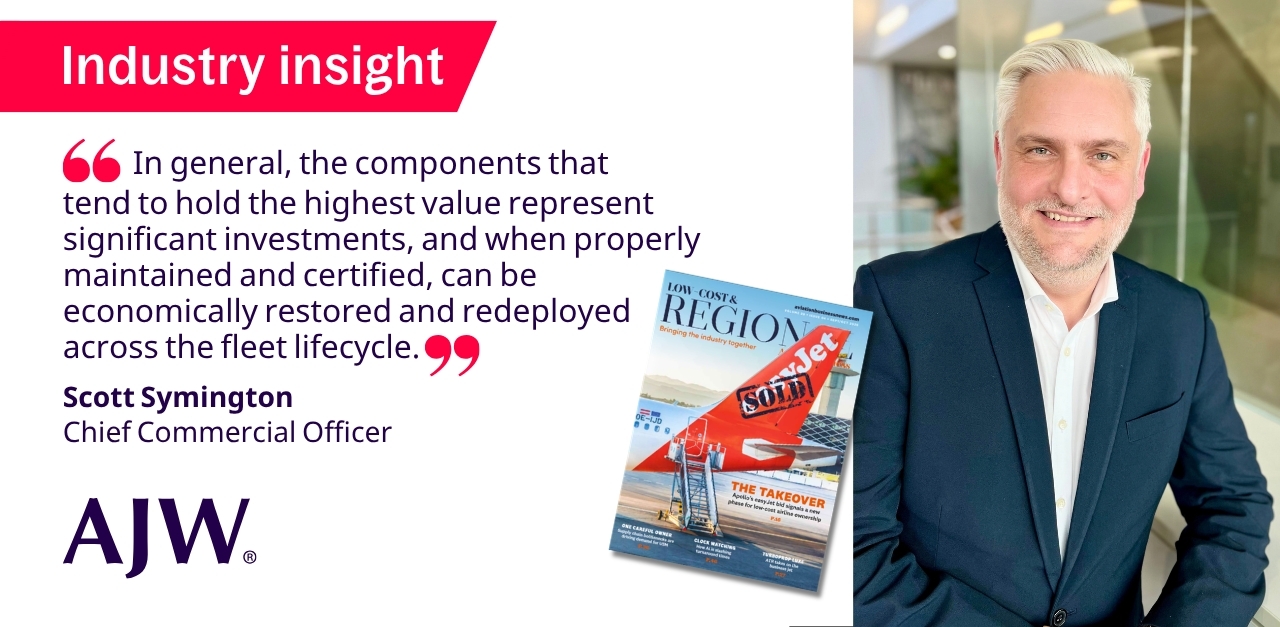
For operators, particularly those managing mature fleets, USM provides a cost-effective alternative to purchasing new OEM components. As Scott Symington, Chief Commercial Officer at AJW Group, explains: “In general, the components that tend to hold the highest value represent significant investments and, when properly maintained and certified, can be economically restored and redeployed across the fleet lifecycle.”
That value is reflected in AJW’s own inventory. The Group holds 450,000 line items, the majority of which are reused and recertified. Its in-house MRO capability at AJW Technique in Montreal also allows components to be repaired and returned to service, helping make greater investment in USM economically viable.
Changing market conditions are also influencing which aircraft become sources of material. As older aircraft remain operational longer, the supply of legacy components from traditional teardowns has tightened. At the same time, shortages elsewhere in the market mean even younger aircraft can present opportunities for part-out.
As Scott notes, “Tearing down younger aircraft might sound counterintuitive, but when it comes to aircraft, it is not purely about age.” Engine reliability and the availability of spares can alter the economics considerably, with AJW increasingly looking at more modern teardown assets where there is value.
In an article originally published by Low Cost & Regional Airline Business, Scott explores how the spare parts market has evolved since Covid and why USM has an increasingly important role to play.
Aviation will always face disruption. But as Scott observes, the industry has “learnt to be incredibly resilient and agile” in response. The experience of recent years suggests that adversity has helped reshape the spare parts market.




 RSS news
©2026 A J Walter Aviation Limited


 Email to my diary