

24/7 AOG Critical Response
Hotline UK +44 1403 798888US +1 877 780 2008
Our award winning global AOG service is manned 24 hours a day, 365 days a year.
Please call +44 1403 798888 or email aog@ajw-group.com.
CLOSE
24/7 AOG Critical Response
HotlineUK +44 1403 798888US +1 877 780 2008
Our award winning global AOG service is manned 24 hours a day, 365 days a year.
Please call +44 1403 798888 or email aog@ajw-group.com.

AJW CUSTOMER ACCOUNT
Existing AJW customers can benefit from a secure online account, giving instant access to the real-time information you need, when you need it most.




7 May 2026

The aviation supply chain operates under immense pressure, and airlines face a complex balancing act between maintaining operational reliability and managing efficiency. In a climate where component availability remains unpredictable and demand patterns continue to shift, are businesses adopting a more agile approach and adapting with improved resilience or not? Airliner World investigates.
Amid the struggle to attain raw materials and a workforce pushed to the limit, a single supply chain failure can ground an aircraft, disrupt schedules, and impact operator profitability. Yet the traditional approach, building large internal inventories or managing multiple vendor relationships independently, has become increasingly difficult.
There is a move to outsource inventory management and supply chain operations to specialist companies, thereby transferring inventory holding and accurate demand forecasting to businesses like AJW Group.
AJW has built strong relationships with numerous OEMs and third-party MROs, including its in-house facility, AJW Technique. This enables them to offer “economies of scale to procure and supply components more efficiently than airlines possibly could,” says Simon Merriott, SVP of Customer Service at AJW Group.
By aligning with experienced supply chain specialists, operators can focus on their core mission whilst their partners handle the complexity of parts positioning, demand forecasting, and logistics execution.
Speaking about the Group’s PBH (power-by-the-hour) programme, the SVP notes, “By shifting maintenance risk to a company such as AJW and setting fixed rates per flight hour, airlines gain a higher degree of cost visibility and budget control,” both vital during periods of economic volatility and high inflation.
When asked about supply chain challenges like the skilled labour shortage, delay in aircraft and engine deliveries, and the length of turnaround times, Merriott says, “AJW Group has implemented automated inventory tracking and management processes, reducing errors and delays. These forecasting tools can improve the ability to meet customer needs effectively, thus reducing inefficiencies in the supply chain."
The AJW teams also employ predictive maintenance analytics to monitor trends across aircraft systems and component lifecycles, meeting customers' needs.
"In an AOG scenario, speed begins with proximity. The main base kit of no-go items is located on-site at the airline's own facilities, enabling the carrier to pull the required component immediately, avoiding handover delays and reducing overall recovery time when urgency is at its peak, " offers Merriott.
How easily can this independent supply chain integrator get parts to where they are needed?
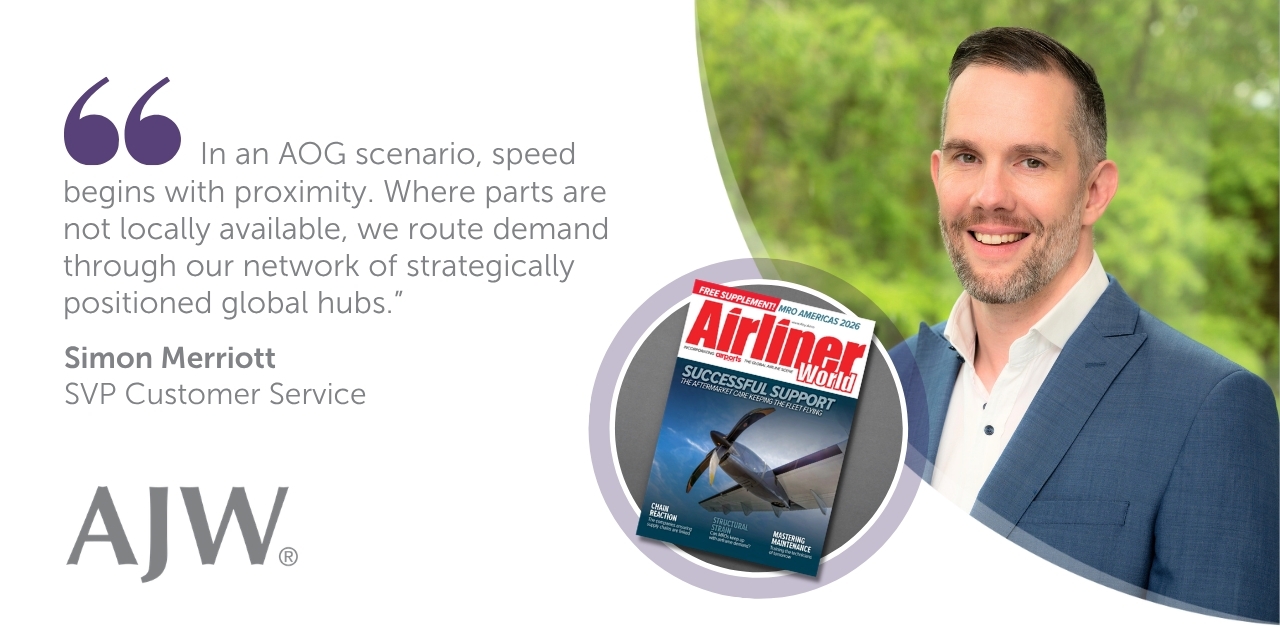
“Where parts are not locally available, we route demand through our network of strategically positioned global hubs, supported by automated warehousing systems to accelerate picking, packing and dispatch."
The journalist concludes the article on an optimistic note, saying experts expect the supply chain to improve over the next two to three years, and businesses that have adopted agile operations will benefit.




 RSS news
©2026 A J Walter Aviation Limited


 Email to my diary