

24/7 AOG Critical Response
Hotline UK +44 1403 798888US +1 877 780 2008
Our award winning global AOG service is manned 24 hours a day, 365 days a year.
Please call +44 1403 798888 or email aog@ajw-group.com.
CLOSE
24/7 AOG Critical Response
HotlineUK +44 1403 798888US +1 877 780 2008
Our award winning global AOG service is manned 24 hours a day, 365 days a year.
Please call +44 1403 798888 or email aog@ajw-group.com.

PBH CUSTOMER PORTAL
A secure online portal for existing AJW PBH customers. Manage exchange orders, track shipments, monitor repairs, access documentation, and communicate with support in real time.




9 Jul 2026

As the aviation industry continues its journey towards a more sustainable future, MRO providers have an increasingly important role to play. While much of the conversation around sustainability focuses on aircraft technology, alternative fuels, and operational efficiencies, the work taking place behind the scenes in component maintenance facilities like AJW Technique is equally vital. By extending the life of aircraft parts, reducing waste, and embracing more responsible resource management, MRO organisations are helping to create a more circular aviation ecosystem. But what does sustainability look like in practice for a modern MRO operation, and how can maintenance providers balance environmental responsibility with the rigorous safety, certification, and traceability standards the industry demands?
In the latest edition of Aviation Maintenance Magazine, Louis Philippe Mallette, CEO of AJW Technique, shares how AJW Group is embedding sustainability across its global operations and driving meaningful environmental improvements throughout its maintenance activities.
As a signatory of the United Nations Global Compact (UNGC) since 2023, AJW Group has aligned its business strategy with internationally recognised principles covering environmental stewardship, human rights, labour standards, and anti-corruption. This commitment is reflected in practical actions across the organisation, from reducing energy and water consumption to minimising waste through recycling and repurposing initiatives.
“Repairing a part is always more sustainable than purchasing a new one. We promote re-use and recycling across our global operations wherever possible” – Louis Philippe Mallette, CEO AJW Technique.
At the heart of AJW Technique’s approach is the belief that MRO facilities are, in many ways, aviation’s recycling plants. By repairing, maintaining, and overhauling aircraft components, the company keeps valuable materials and parts in circulation for longer, reducing the need for replacement manufacturing and preventing unnecessary waste from reaching landfill.
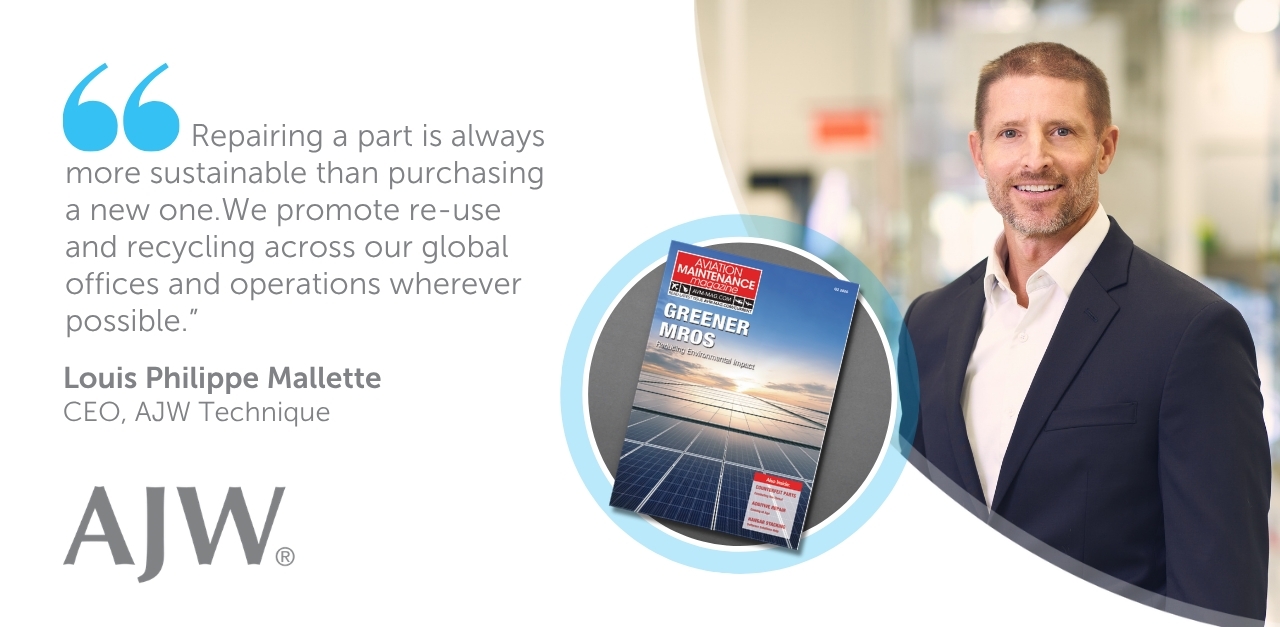
The article also explores how AJW Technique is tackling some of the most significant environmental challenges facing MRO operations today, including the management of chemicals, fluids, scrap materials, and packaging waste. Through innovative practices such as filtration systems, fluid-life extension programmes, and the adoption of recyclable packaging alternatives, the company continues to reduce its environmental footprint while maintaining the highest operational standards.
Louis also discusses the important role of repair development in supporting sustainability. Rather than replacing components unnecessarily, AJW Technique’s engineers focus on identifying opportunities to repair and restore parts wherever possible, ensuring they continue to meet strict airworthiness requirements while delivering environmental and cost benefits.
Beyond the workshop, AJW Group is investing in greener facilities, including solar energy generation, battery storage systems, rainwater harvesting, and energy-efficient technologies that are helping reduce emissions and optimise resource consumption across its global sites.
Wondering how AJW Group is helping shape a more sustainable future for aviation maintenance?




 RSS news
©2026 A J Walter Aviation Limited


 Email to my diary