

24/7 AOG Critical Response
Hotline UK +44 1403 798888US +1 877 780 2008
Our award winning global AOG service is manned 24 hours a day, 365 days a year.
Please call +44 1403 798888 or email aog@ajw-group.com.
CLOSE
24/7 AOG Critical Response
HotlineUK +44 1403 798888US +1 877 780 2008
Our award winning global AOG service is manned 24 hours a day, 365 days a year.
Please call +44 1403 798888 or email aog@ajw-group.com.

PBH CUSTOMER PORTAL
A secure online portal for existing AJW PBH customers. Manage exchange orders, track shipments, monitor repairs, access documentation, and communicate with support in real time.




23 Jul 2026

Waste not, want not – a well-known adage, but one that seems apt when discussing inventory management in aviation. Holding excess stock equates to tied-up capital. Capital that could be better allocated elsewhere. Managing surplus inventory is a precarious balancing act that requires a disciplined inventory strategy. Which begs the question: How much inventory do you hold, and who can you rely on when you have an AOG situation and need to source parts through third-party parts suppliers?
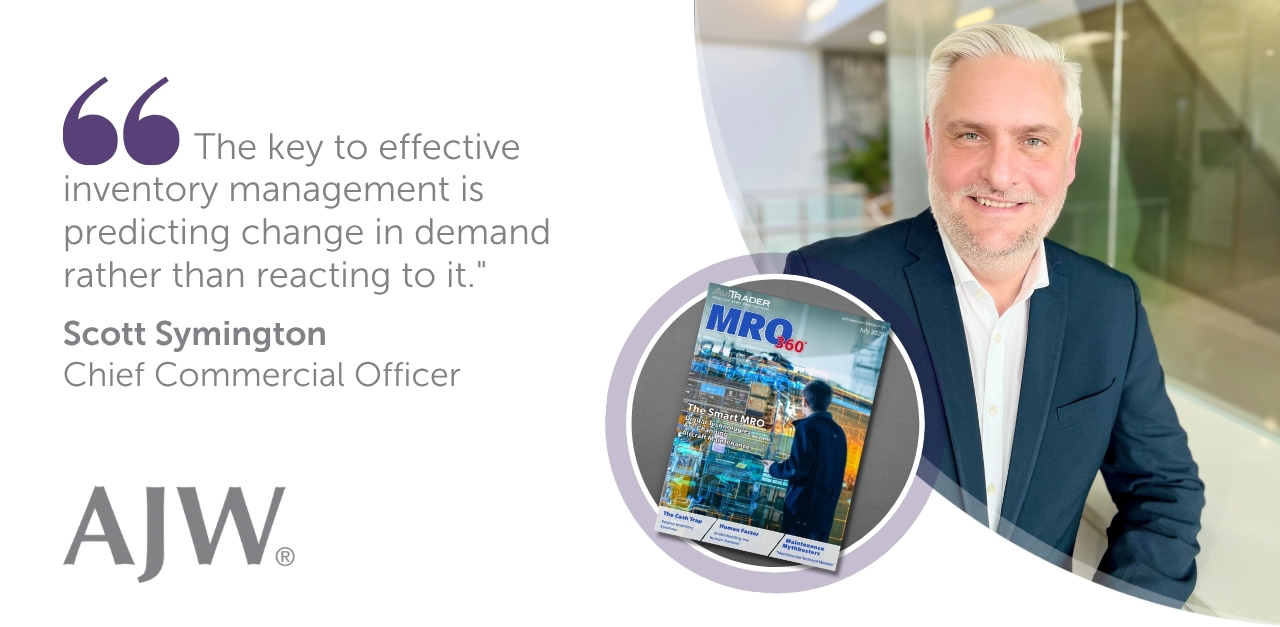
AviTrader MRO 360 spoke to industry experts, including AJW's Chief Commercial Officer, Scott Symington, who says effective surplus inventory management starts long before stock becomes surplus. While excess inventory is often associated with poor forecasting, the reality isn't always that straightforward. In aviation, uncertainty is a constant. The ever-present risk of Aircraft on Ground (AOG) events means MROs and operators must hold sufficient stock to protect service levels, but changing market conditions can quickly transform sensible safety buffers into costly excess inventory.
According to Scott, " The solution lies in moving from reactive inventory management to predictive, data-driven decision-making." High-quality data, demand visibility, and advanced analytics enable organisations to understand customer requirements, monitor inventory ageing, and anticipate demand shifts before they occur.
Without this visibility, businesses risk making purchasing decisions based on incomplete information, leading to overstocking, understocking, and unnecessary capital being tied up in inventory. "If you're consistently taking losses on surplus inventory, the conversation needs to shift upstream to your purchasing strategy, forecasting discipline, and demand visibility," states the Group CCO.
Scott also highlights the importance of selecting the right commercial frameworks to support inventory discipline. Whether through PBH (power-by-the-hour) programmes, pooling arrangements, or consignment models, successful strategies rely on robust data, transparency, and the flexibility to adapt as operational requirements evolve.
When surplus inventory does arise, specialist asset management partners like AJW Group can play a critical role in maximising returns through accurate asset valuation, detailed technical records, strategic teardown, harvest planning, and access to global aftermarket networks.
Ultimately, Scott believes that losses on surplus inventory are rarely created at the point of sale. Instead, they are often the result of purchasing decisions made months or years earlier. Organisations that combine forecasting discipline, market intelligence, and strong demand visibility are best positioned to minimise surplus, preserve capital, and maintain the inventory resilience required to support customers when it matters most. Offering sage advice, Symington offers, "The key to effective inventory management is predicting change in demand rather than reacting to it."
Read the full AviTrader MRO 360 feature to discover Scott's insights and recommendations for balancing inventory risk, operational readiness, and commercial performance.




 RSS news
©2026 A J Walter Aviation Limited



 Email to my diary